

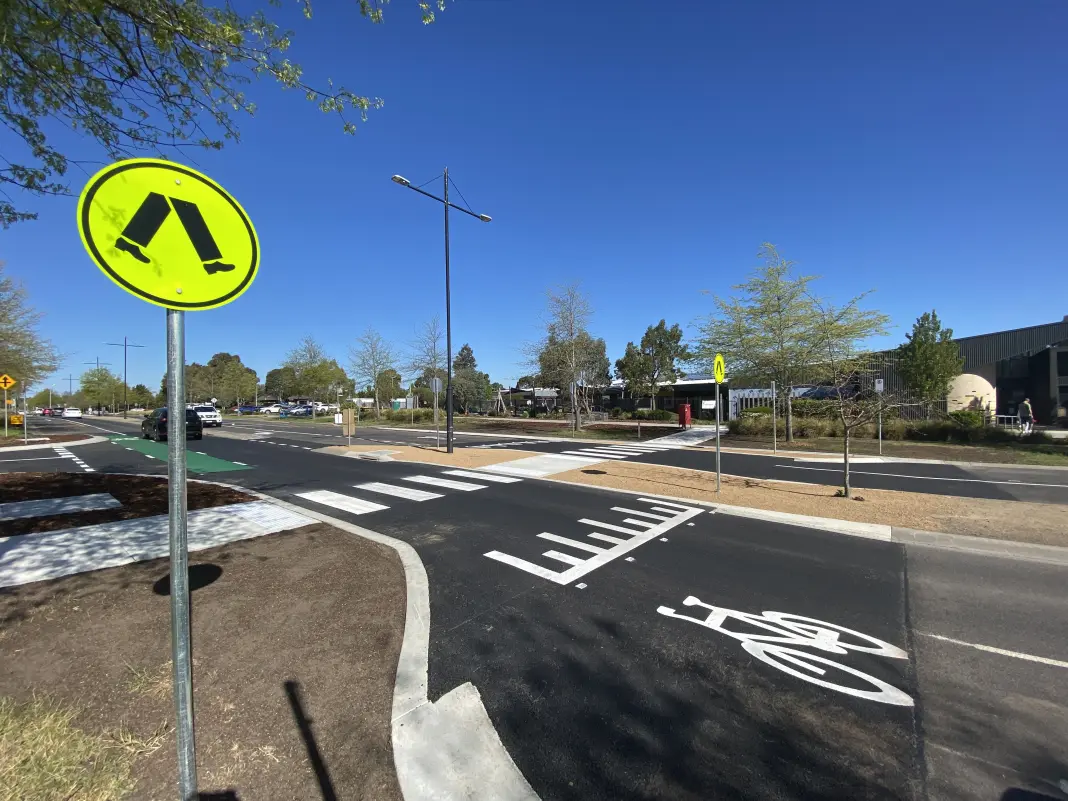



MAJOR funding boosts are set to hit regional Victoria as the State Government invests millions of dollars in the Safe Local Roads and Streets Program.
Local projects include a $442,000 investment in Wallan’s growing Wallara Waters Estate, which will deliver speed limit reductions, raised crossings and traffic calming measures to improve safety for local residents.
The government is investing $28.7 million for the upgrades, with $17.2 million of that set for regional Victoria.
More than 430 projects have now been approved across Victoria with all 79 councils participating in the program.
Minister for Roads and Road Safety Ros Spence said the new projects will make roads a lot safer around the state.
“We’re partnering with councils to deliver practical safety upgrades on the local roads Victorians use every single day,” Ms Spence said.
“These projects will make local streets safer for drivers, pedestrians and cyclists right across the state.”
The Safe Local Roads and Streets Program is part of the overall strategy for Victoria’s roads strategy which aims to halve roads deaths by 2030 and completely eliminate road deaths by 2050.
The program was developed by the Transport Accident Commission (TAC) in partnership with the Department of Transport and Planning (DTP).
The TAC road death statistics show that 100 people have died on Victorian roads this year.
TAC CEO Tracey Slatter said pedestrians and cyclists are over‑represented in serious injuries on local roads and this program is aimed at reducing risk where it’s needed most, making everyday trips safer for all road users – particularly those that are more vulnerable.
In discussing its own Road Safety plan, Mitchell Shire councillors were split on the issue, before eventually narrowly passing on a 5-4 vote last Monday night.
Councillor Ned Jeffrey said that the plan, while fully supportive of the overall strategy, too much emphasis was placed on speed limit reductions.
“I’d like to speak against this proposal. While I fully support the overall strategy of bringing awareness to the issue of road trauma and also acknowledging the impact that such incidents can have on individuals’ families and the wider community, this strategy actually puts too much emphasis on the reduction of speed limits,” he said.
“We are almost 100 per cent reliant on our road network. You can’t move freight, you can’t transport yourself or any of your belongings without going on a road.
“So this particular strategy in front of us basically says that we plan on reducing speed limits. Whenever you reduce the speed limit, say from 100 to 80 as we’ve seen this year, you are reducing the productivity of the community by at least 20 per cent.
“I strongly encourage this strategy to be re-written with a focus on many of the other items that can be done to reduce road trauma, improving licensing, improve safety of cars, improve road safety, many other initiatives that are skimmeded in this strategy, but not focused upon like the speed reduction is, and we’ve seen recently this year.”
In supporting the motion, Cr Nathan Clark said there was a big effort to support roads, but a pathway to get to zero.
“It’s an admirable goal to have zero fatalities and injuries. There’s certainly many pathways to get there,” he said.
“It shows what a wicked problem roads are for Mitchell Shire Council and what our responsibility is.”
Cr Timothy Hanson said the road safety strategy was shaped by the community.
“Victoria has a statewide target to halve road deaths by 2030, and we aim to exceed that, which I think is fantastic. The strategy was shaped by the community, with 75 online survey responses, in person, in Wallan and Broadford, as well as workshops with Victoria Police, Ambulance Victoria, the CFA, SES, DTP, the Department of Education and a two-week public consultation,” he said.
Councillors Clark, Bob Cornish, Hanson, Claudia James and Andrea Pace voted for the plan, while Crs Jeffrey, John Dougall, Riley Evans and Bob Humm voted against, which meant the plan was carried.

