

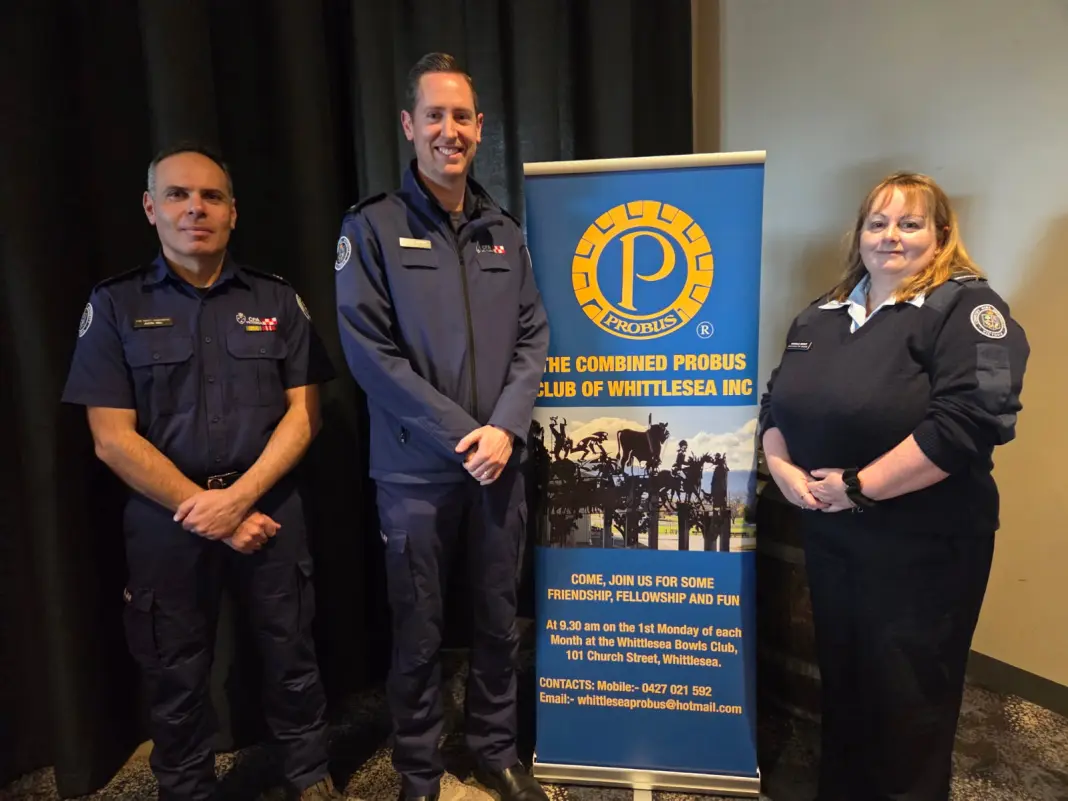



IN the fire service, “fully involved” describes a maximum-intensity scene where everything is engaged; and that’s exactly what the trio of Country Fire Authority (CFA) members were when they addressed Combined Probus Club of Whittlesea members at their August meeting.
The CFA is a vital part of the Whittlesea community. All over the country when help of any sort is needed the CFA or interstate equivalents spring into action.
Captain Richard Gardiner, Justin Meli, FireFighter and Land Use Planning Coordinator and Rachelle Bishop, the Secretary and Reporting Officer responded to the request to address the Probus Club members A firefighting team was established as the Whittlesea Fire Brigade by local volunteers on December 17, 1926, following severe bushfires that swept from the Mt Disappointment Ranges. Future generations kept the brigade alive and vibrant.
The CFA was formed in 1943. It is still a volunteer fire service that has a presence in 1200 locations across Victoria beyond the metropolis of Melbourne. Like any good Captain Richard led the presentation with a particular emphasis on the Golden anniversary festivities currently being formalised.
A brief overview of the various tasks that members undertake was usurped when we learnt that in 2008 Whittlesea CFA was one of the first brigades to take on increased skills to assist Ambulance Victoria as part of the Emergency Medical Response project, now referred to as Fire Medical Response. Select volunteer brigades respond to life-threatening medical calls such as cardiac arrest, respiratory arrest, stroke, and anaphylaxis.
The focus of Richard’s messaging was about home safety and actions that the public should consider. For the farm and forest areas of Whittlesea, a bushfire plan is vital. In the urban areas home safety is important. Smoke detectors are the corner-stone of home safety and need regular monitoring. Depending on the age of the home different alarm systems exist but all need the homeowner to have them as part of a fire plan. We were encouraged to fit an alarm in all bedrooms and as added safety to close the door at night if not occupied.
Justin Meli explained how the CFA is part of Victorian Planning Provisions, which regulate land use and development to manage bushfire hazards and risks. The framework ensures that planning decisions and building permits consider bushfire protection, integrating state-level policies with site-specific requirements to avoid duplication and enhance safety outcomes. The primary objective is to strengthen the resilience of communities and settlements, prioritising the protection of human life over all other policy objectives.
The local council draws information from all agencies when making a decision about a Planning Application before making the decision. But Justin’s message was that fire does not consider planning permits, again reinforcing the need for a dedicated bushfire Plan.
In the event that the CFA responds to a fire the Crew Leader makes the decision for safety of the crew and whether to stay and fight or abort.
He explained about fire hydrants locations and how the road markings indicate their presence. All properties need to have large highly visible numbers so delays are not encountered. The entrance, driveways and an eight meter turning circle at rural properties are all vital and detailed so that fire vehicles can safely enter.
A Bushfire Attack Level rating is a measure of how much risk a building site faces from bushfire exposure. It considers the three main ways a fire can impact a property: ember attack, radiant heat, and direct flame contact. These risks are assessed using a national standard AS 3959 that determines how to classify and manage bushfire threat levels for buildings.
An issue applicable to citizens irrespective of living location was a major part of question time. The answer to all related discussion is “be careful with rechargeable batteries”.
The time allocated for the meeting came to an end with members wishing for more. They gave the presenters a round of applause and they departed with a small token of appreciation.


