

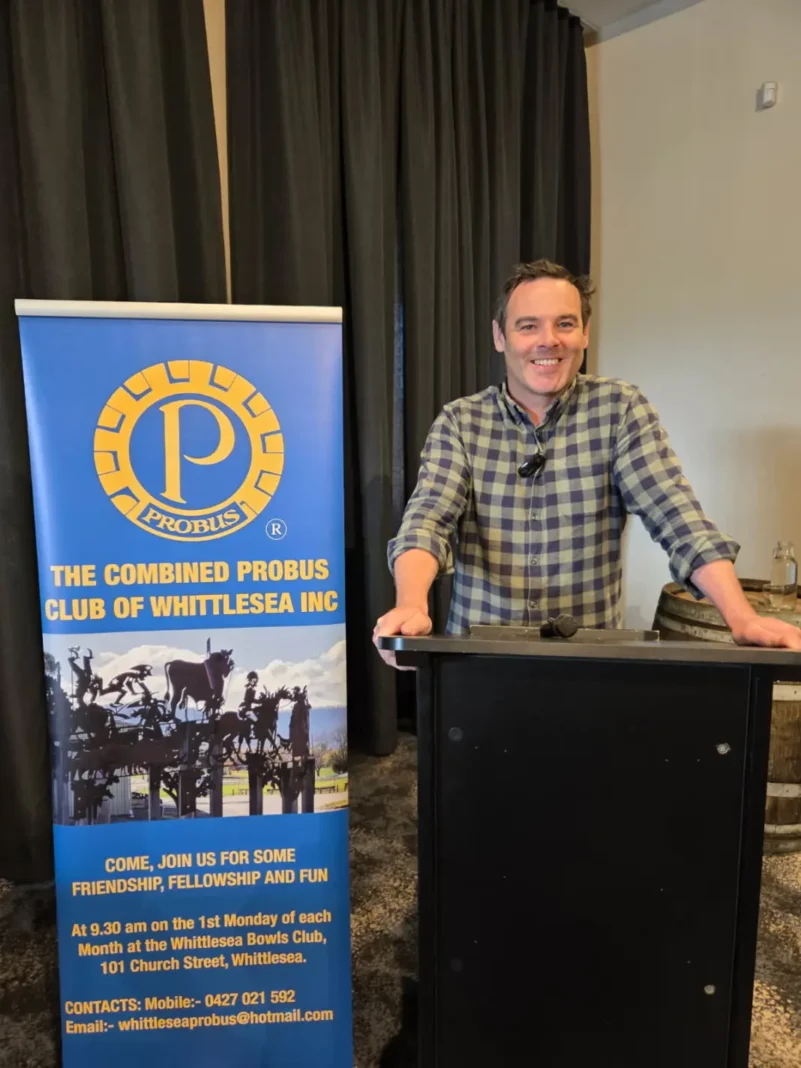




THE 2026 year at the Combined Probus Club of Whittlesea got off to an informative and thought-provoking start on Monday, February 2, with guest speaker Sam White of Sidonia Beef sharing the remarkable story of his family’s farming journey and its transformation through regenerative land management.
Sam is the current manager of Sidonia, a 150-year-old family property located north of Kyneton. The farm’s direction changed dramatically in 1997 when two sheep from a flock of 6000 merinos tested positive for Ovine Johne’s Disease (OJD), an incurable and highly contagious wasting disease affecting sheep and goats. As required, the entire flock was destroyed and the property was destocked for two summers, forcing the family into what Sam described as a farming “recession”.
It was during this challenging period that Sam began exploring Regenerative Land Management (RLM), an approach that works with natural systems rather than against them. He explained the distinction between sustainable and regenerative agriculture, noting that while sustainable farming aims to maintain the status quo, regenerative agriculture seeks continuous improvement by restoring and enhancing natural cycles such as soil health, water retention and biodiversity.
Sam highlighted research suggesting that nearly two-thirds of Australia’s agricultural land has been degraded by past farming practices.
While acknowledging that each generation farms with the best knowledge available at the time, he said some once-common practices, including superphosphate use and chemical drenching, were later found to be detrimental. These inputs are no longer used at Sidonia Beef, significantly reducing costs. Today, the only regular expense is electronic ear tags for new calves, though soil tests still detect traces of synthetic fertiliser decades later.
Since 2005, the property has been managed using organic principles and a holistic, soil-based approach. Cattle are run as a single herd and used as a tool to regenerate the land, trampling manure into the soil, stimulating new plant growth and allowing paddocks time to recover. This managed movement has increased biodiversity, improved water quality and restored soil health. An unexpected outcome has been that longer grass growth encourages kangaroos to move elsewhere.
Sam also touched on changes in cattle behaviour, suggesting that constant close company and chemical-free management may have influenced natural breeding patterns.
While some cattle are sold through traditional markets, about 20 per cent are sold directly to consumers as Sidonia Beef Boxes, containing 5kg or 8kg of 100 per cent pasture-raised Black Angus beef. Each box uses the whole animal, resulting in minimal waste and truly meeting “paddock to plate” principles.
Probus members were left with a clear message: regenerative farming offers significant environmental, economic and ethical benefits, and Sidonia Beef stands as a compelling example of farming in harmony with nature.