Home Blog Page 860

Broadford school’s charity fundraiser

By Steph McNicol

BROADFORD Secondary College banded together to raise more than $4000 for The World’s Greatest Shave on Friday, with four teachers and a student taking on the challenge.

Building and construction teacher Greg Sharp tasked the students, who initially aimed to raise $3000, with raising more than $4000, so he would shave his pride and joy – a moustache he had grown for 42 years.

The students and their efforts meant they smashed the goal, and Mr Sharp parted ways with his favourite feature.

“The moustache was starting to get a bit grey, and people started saying to me, even one of my kids, ‘oh you need to dye it’,” he laughed.

The cause is one close to Mr Sharp’s heart.

“My wife, three years ago, passed away from cancer, my mother-in-law passed away from breast cancer,” he said.

“If you’re going shave it off, you may as well shave it for a reason.

“I said if we can get $4200, I can’t believe there’s that many people that actually said ‘good, we want it gone’.”

IMG 0389
Broadford Secondary College teachers and students banded together for The World’s Greatest Shave. Pictured, from left, is Meraki hairdresser Baz Kennett, teachers Glenden Hickson, Matt Rose, David Dixon, and Greg Sharp, and front, students Brydon Carter and Sarah Warren.

The project organiser, a year 12 VCAL student, said she only had 17 days to organise the event, and she was challenged by Mr Sharp to reach the target.

“I don’t think he’s nervous, maybe just about the white patch that will be there underneath it,” she laughed.

“We’ve got one of the boys from school [shaving his head] and he’s in year 11. He’s got a big mop of curly dark brown hair and he wanted to do something like The World’s Greatest Shave,” Sarah Warren said.

“We had quite a tight time limit with only 17 days to organise it all. We put it out to the school [asking] who wanted to join in, and we got [a few] teachers involved.

“A lot of our students or people in the community are affected [by cancer], so it’s a close thing to our school.”
IMG 0378
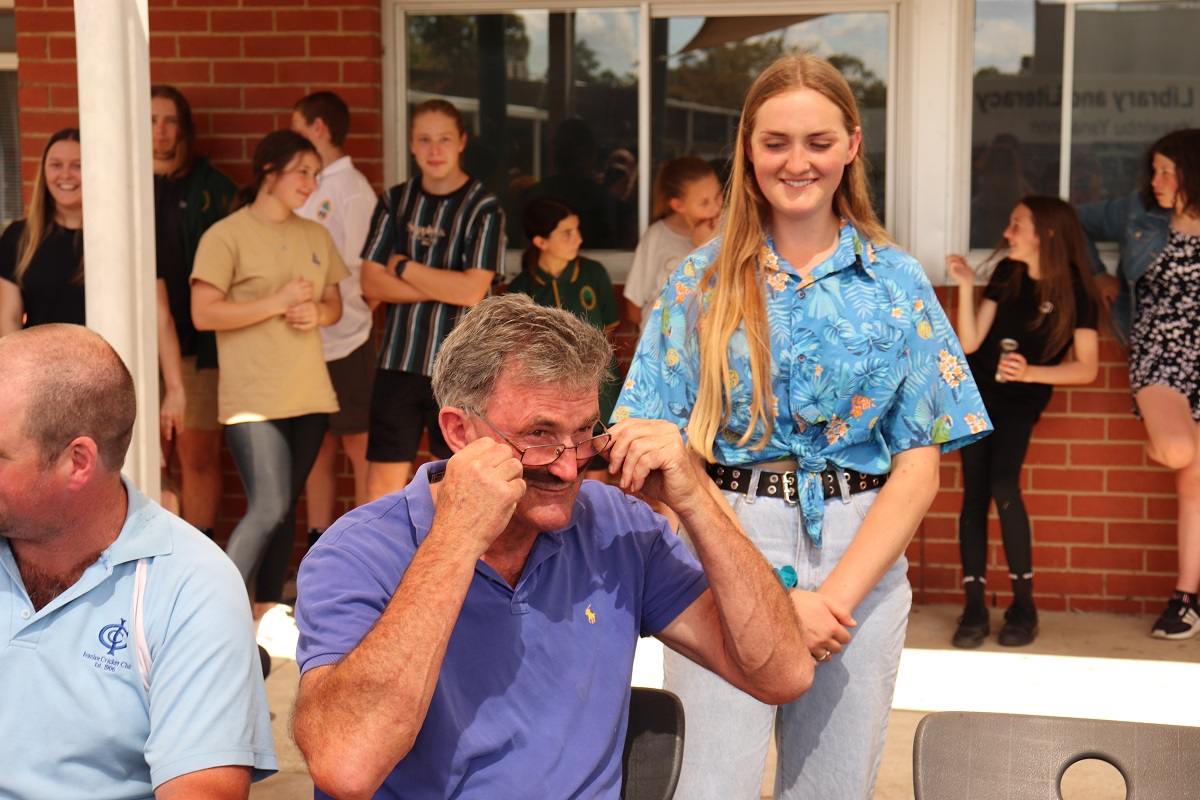
Greg Sharp, known as ‘Sharpy’, missed his moustache instantly, and decided to use some of Brydon’s hair to fill the empty space.

Year 11 student Brydon Carter said he participated in the shave in honour of his nan who fought a winning battle with breast cancer.

Brydon raised more than $1000 on his own tally, and said he was thankful for the support.

“I just wanted to thank everyone who’s helped me do it and donating money, it’s amazing what they’ve done,” he said.

Meraki Hair and Beauty hairdresser Baz Kennett completed all five shaves, and said he was happy to be giving back.

“I sponsor Seymour FM, and I’ve got a relationship with Greg … I do [his] hair. So, we just built a connection there and they’ve asked me to come do it. I said to Greg, he will probably need a bit of spray tan to cover [his lip],” he laughed.

Cultural Diversity Week celebrates inclusivity

The City of Whittlesea is hosting a series of art, film, music and language events and workshops over the next fortnight, celebrating belonging, inclusivity and the municipality’s rich cultural and linguistic diversity.

The program is across Harmony Week, the five days in the lead up to Harmony Day on March 21, and Cultural Diversity Week, which falls on the following week.

Harmony Day, now in its 22nd year, coincides with the United Nations International Day for the Elimination of Racial Discrimination, while Cultural Diversity Week, from March 21 to 28, is Victoria’s largest celebration of multiculturalism.

Whittlesea’s centrepiece artwork is Listening to Land, a public installation by several artists, including paintings by Simeon Walker and Wurundjeri artist Mandy Nicholson; Birrarung, a film composition by Maudie Palmer; and the Solace Stream by landscape artist Vin Anderson.

Mr Anderson used rocks, branches and water to create a running stream on the tiled floor of the council offices’ Great Hall in South Morang.

“We’ve brought in some sights and sounds, bush, trees, some noise with the water, smell with the eucalyptus. Everything is sourced locally and will all go into another project next,” he said.

Taking cues from patterns found in the area’s landscapes, the Solace Stream invites visitors to reflect on the importance of nature on residents’ wellbeing throughout lockdown last year, and what they may have discovered in their areas.

“We want to reflect what people have been finding, particularly in the last 12 months, down these little streams, nooks and crannies around their own area,” Mr Anderson said.

“I’d like people to walk in the door and say ‘wow’, and then feel something different, smell something different and then from there hopefully reflect.”

Much of the two-week program will be at the council offices’ Great Hall alongside Listening to Land.

On March 17 at 6.30pm, visitors will be seated around the stream for a free screening of Small Island Big Song, an internationally renowned documentary film tracing the songlines of communities in the Pacific Islands and the Indian Ocean.

Songlines are a method of storytelling and oral mapping, and have been a prominent element of First Nations communities for tens of thousands of years. ​

Filmed over three years on 16 island nations, the project by Taiwanese producer BaoBao Chen and Australian filmmaker Tim Cole unites hundreds of musicians through song from Hawaii and Madagascar, to Borneo, New Zealand, Taiwan, the Torres Strait Islands and more.

Other featured events include a performance by Australian-Jordanian musician Hana Zreikat on March 18; a workshop and discussion on interpretations and translations of Rumi’s poetry led by Merve Onder of the Islamic Museum Australia, including a poetry-writing session, on March 22; and a lesson in the history and technique of Aboriginal dot paintings by Western Arrarnta, Luritja and Kokotha artist Emrhan Tjapanangka Sultan on March 24. Each event is free but bookings are essential.
The full program runs until the end of March, with Listening to Land open weekdays until May 21.

For more information and bookings visit the City of Whittlesea website, www.whittlesea.vic.gov.au/arts-events-recreation/things-to-see-and-do/events/cultural-diversity-program-2021.

Macedon cafe burgled

MACEDON Ranges Crime Investigation Unit detectives are investigating the theft of tools from a cafe in Mount Macedon last month.

Police allege the offenders arrived at the Cameron Drive address just after 4am on Wednesday, February 10, before entering the business by forcing a door lock.

Capture1

The men gained access to an external storeroom where they stole a water pump, pressure washer as well as other power tools and items.

Police have released pictures of three males they believe could assist with their enquiries.

Anyone with information is urged to contact Crime Stoppers on 1800 333 000 or submit a confidential report online at www.crimestoppersvic.com.au.

Capture2

Council calls for community collaboration

MACEDON Ranges Shire Council thanked Romsey residents who attended a community forum last month to discuss ‘multi-faceted’ issues and said a community approach was essential.

The forum, hosted by Victoria Police, came to be after Romsey man William Nixon expressed his concern for the lack of action by police and council surrounding several youth and safety issues in the town.

The community gathered at Romsey Mechanics Institute where they were given the opportunity to speak with council representatives, a youth worker for the shire and Romsey police Sergeant Eddy Barake.

Some of the main issues raised at the forum included the safety of residents while making use of public spaces, particularly the Romsey skate park, the anti-social behaviour by youth in the shire, and the lack of appropriate activities and facilities made available for youth in the region.

Many residents questioned council and police about the length of time it took for them to act on the issues.

Council issued a statement earlier this month to thank residents for their attendance.

“Hearing from residents, community groups, and community members of all ages, has shown that a combined council, police and community approach will be essential when tackling the multi-faceted issues raised,” the statement read.

“Council recognises the need for ongoing communication with the people of Romsey, providing updates as well as chances to hear concerns and feedback. This is a highly-engaged community who are coming together to express their concerns and find possible solutions.

“Council will work with Victoria Police to provide additional opportunities like Wednesday’s forum for community discussion and input.”

Council said the forum demonstrated providing a space for young people to voice their concerns and advocate for changes meaningful to them was a crucial part of the conversation.

“While it can be easy to group young people in the ‘youth’ catch-all, there are a range of different needs of the young people in Romsey based on interests and age,” the statement read.

“Council plans to further engage with the young people of Romsey via an ideas workshop to hear directly from them about what they want to see. Input will be sought face-to-face and via social media.

“Council recognises that while it is vital to provide services and opportunities for young people in Romsey, it is also important to explore transport solutions that enable young people who cannot drive to socialise with their peers and access services across the shire.

“While COVID-19 restrictions impacted Council’s ability to deliver some youth programs throughout 2020, Council is currently ramping up its youth offering. For current opportunities visit mrsc.vic.gov.au/youth.”

Council said they provided CCTV footage to police ‘willingly’, which was another issue raised by residents.

Although CCTV signage is frequently targeted by vandals and removed, the cameras remain active. Council is in the process of installing more CCTV signage and investigating opportunities for additional cameras.

“Council contractors clean and inspect facilities every morning and evening Monday to Friday, and Security Patrol Officers visit Lions Park Reserve Romsey and Romsey Skate Park to close the toilets on Saturday and Sunday nights,” the statement read.

“Council would like to remind the community to please call 000 for police attendance or in the case of emergency or contact the non-emergency police line on 131 444.

“Please contact Macedon Ranges Shire Council at 5422 0333 to report facilities damage or suspected breaches of the local law.”

Sports grounds upgrades

By Aleksandra Bliszczyk

The City of Whittlesea lsat week announced a new synthetic pitch would be installed at Lalor United Sloga Football Club in October.

The council has also applied for a grant through the Community Sports Infrastructure Stimulus Program to enhance further works.

The home turf of soccer club hasn’t had any upgrades since the club moved to the site in 1979.

The deteriorating surface condition of the natural turf means that HR Uren Recreation Reserve, Thomastown, no longer meets Football Victoria’s minimum facility standards, or the needs of the broader community.

Further upgrades include a pavilion and carpark extension, and the creation of a multi-purpose social space that will be available for community use and provide recreational participation opportunities for residents.

Council applied for the grant after receiving an invitation from Sport and Recreation Victoria. If approved, the $3.7 million in funding will increase the scale of the upgrades.

Club coordinator Emil Atanasov said the club had been pushing for upgrades for years and was grateful to council for getting the ball rolling. 

“Over the years it’s been ditches here, ditches there. Council do their best to try and fit it, but 42 years of people playing on it and not being resurfaced, there’s a lot of wear and tear,” he said. 

“That ground will be fixed and it will be immaculate. It will be synthetic and it will be exactly what the new generation wants.

“The other extension we’ve been pushing for a long time because our numbers are up but there’s nowhere for people to meet and greet, all we have is change rooms, so we’re very grateful to council for all the work they’ve put in.”

At last month’s council meeting, director of community wellbeing Kate McCaughey said the grant application delayed the construction, but the added funding would be better for the club in the long term.

“Lalor Football Club has been consulted through the development of the proposal, and whilst they’re supportive of the project they’re naturally disappointed about the proposed delay that this might cause. But they are very supportive of council’s approach to apply for the SRV grant because of the enhanced amount of works that we’ll be able to achieve,” she said.

“In some ways delaying the project while we wait to sync with the grant application is actually advantageous for the club’s fixturing as this pushes the [construction] commencement date until after the regular soccer season.”

Works on the pitch will commence in October and are due to be completed before the start of the 2022 soccer season in March. Design work is underway for the pavilion and carpark extensions. 

“We’re assuming it’s going to attract a lot more people in the area,” Mr Atanasov said.

“We expect girls’ numbers to be up [and] junior numbers to be up.”

Lalor United Football Club is one of the largest football clubs in the municipality, with more than 300 members across 22 teams, consisting of four senior men’s, three junior girls’, four junior boys’ and 11 mini-roos teams.

The extension will provide the pavilion the potential to accommodate for non-sport community groups such as the Tamil/Hindu community, seniors’ groups and gentle exercise.

Whittlesea administrator resigns

City of Whittlesea administrator Bruce Billson has resigned his position to accept a new national role as small business ombudsman for the Federal Government.

Mr Billson was appointed to the panel of administrators last year after the State Government sacked the previous council when a report by the municipal monitor found that its governance had irretrievably collapsed. 

Mr Billson’s resignation is effective immediately, and it is the role of the State Government to appoint a new administrator to the City of Whittlesea, which will be announced in the coming weeks.

Council chair administrator Lydia Wilson and administrator Peita Duncan said they remained committed to their roles and the work they were undertaking.

“There will be no change to any of council’s plans, projects or decisions due to this resignation, and our community can be assured that Peita and I are fully committed to our administrator roles at Council for the full term of our appointment until 2024,” Ms Wilson said.

Mr Billson has had a significant career in politics, including multiple parliamentary secretary roles and holding elected office in the House of Representatives for Dunkley, Victoria over several terms. 

During his eight months as administrator, Mr Billson supported both Ms Wilson and Ms Duncan in their roles, which Ms Wilson said was productive.

“Together, administrator Peita Duncan, Bruce and myself have enjoyed a united and respectful relationship dedicated to providing the best outcomes for people living and working in the City of Whittlesea,” she said. 

“We have also made significant headway in restoring governance at council in a short period of time.

“We will certainly miss Bruce’s energy, passion and ideas that he brought to briefings, council meetings and when engaging with our community.”

Ms Wilson said she looked forward to the government announcing a replacement administrator for the City of Whittlesea. 

New platypus protection initiative

By Aleksandra Bliszczyk

The City of Whittlesea, RMIT and the Merri Creek Management Committee have launched a new joint initiative to ensure the Merri Creek continues to be a healthy and habitable environment for aquatic animals including the platypus.

The Water Quality Monitoring in Merri Creek project is part of council’s new Whittlesea Water For All water strategy, which was formally endorsed at the December council meeting.

The project comes after the State Government listed the platypus as a vulnerable species in January, and committed $300,000 to a long-term plan to restore key platypus habitat sites.

Although platypuses can be found in a range of climate regions across Australia, a 2020 study by the University of New South Wales found platypus habitat nationwide had declined by 22 per cent, or 199,919 square kilometres, in the past 30 years – an area three times the size of Tasmania.

As platypuses feed and breed in water, their lives depend on healthy waterways, which are most threatened by land-clearing, regulation of rivers and drought, according to the study.

Council’s stormwater harvesting coordinator Edmond Lascaris explained the project involved setting up sensors that would monitor the creek’s turbidity – how clear the water was – as an indicator of waterway health, and therefore animal health.

“The network of sensors in the Merri Creek will allow us to see the effects of runoff into the creek, which is particularly important for the Whittlesea municipality with our growth areas and high level of development,” he said.

“This will assist developers to better understand the issue of keeping waterways healthy and enable them to roll out more careful management of construction to minimise runoff into the creek.

“It will help us identify the extent of these kinds of issues and provide real time reporting.”

Beyond its platypus population, the creek is home to other vulnerable species including the growling grass frog and the golden sun moth.

The Whittlesea Water For All strategy aims to see council become a leader in the management of water – including stormwater, potable water, wastewater, rainwater and local waterways – by 2030.

It also addresses the growing risks of flood and drought, and the health of other waterways including Edgars Creek, Darebin Creek and the Plenty River.

Council chair administrator Lydia Wilson said the municipality’s high population growth provided opportunities to adopt innovative water management at crucial stages of development.

“Every year we have more homes and businesses being built. At the same time, science shows that our climate is becoming hotter and drier, and that this will have an impact on the availability of water,” she said.

“This strategy outlines the important step that council will be undertaking around water management for now and in the future.”

Wildlife concerns continue

Macedon Ranges Shire Council will investigate solutions to what residents say is an increase in wildlife being killed or injured on the shire’s roads.

A report detailing opportunities to improve wildlife safety on roads across the shire was received by council at the February ordinary meeting.

The report comes after residents raised concerns about the safety of wildlife in Riddells Creek, New Gisborne, Cherokee and Kerrie areas at council’s meeting in September last year.

Residents pushed for a change of speed limit to 50km/h on some roads where speeds are currently posted at 80 to 100km/h.

Council noted the concerns of residents about collisions on roads and acknowledge the residents’ request to investigate speed reductions.

It will also mean council will direct acting chief executive John Nevins to provide a report on the current planning and management of roads and guidance on the best way to reduce wildlife trauma.

Council’s traffic and road safety engineer Angela Jenks said Macedon Ranges Shire was always attracting new visitors and residents.

“The Macedon Ranges has long been regarded for its natural landscape beauty and wildlife attracting many visitors and new residents to our municipality,” she said.

“Locals, used to driving in areas where wildlife are present, know how to adapt their driving to consider wildlife. This includes knowing when wildlife is most likely to be on the road, either due to the time of day, weather conditions or food scarcity.

“The residential growth in Melbourne and surrounding suburbs has resulted in more drivers on our roads, and some of these drivers are not experienced in driving in rural areas on rural roads.

“Township growth is potentially adjacent to some animal populations’ food or movement corridors. These two things mean in parts of the shire there is more wildlife on or near the road and there are more drivers who are not experienced in driving where wildlife is present.

“This has caused concerns for residents and the community as they report noticing an increase in wildlife trauma.”

Resident concerns primarily fell into three categories including changes in traffic volumes on previously low traffic roads, changes in where wildlife were frequenting, and changes in the vegetation management in certain locations and consequent attraction of wildlife.

Ms Jenks said some people thought increased signage would be the best solution.

“Signage is frequently viewed by people as being the solution, along with speed reduction. Both come with restrictions on when and how they can be used,” she said.

“Signage has limited impact and is best used where there are either frequent experiences with groups of animals, or in areas of noted high incidence of wildlife road trauma.

“Signage is known to be most effective when people first notice a sign, but it soon loses its prominence and is then frequently noted by drivers as more of a landmark. The positive is that this means it is useful in areas where visitors or tourist drivers may frequent.”

Any speed changes on council-managed roads require approval from Regional Roads Victoria.

Ms Jenks said the speed guidelines helped to identify the appropriate speed limit for any given road, based on criteria such as road classification, road characteristics, nature of roadside development, and crash history.

“The speed guidelines do not identify 50 km/h as an appropriate speed limit for rural roads for the purpose of addressing wildlife safety,” she said.