



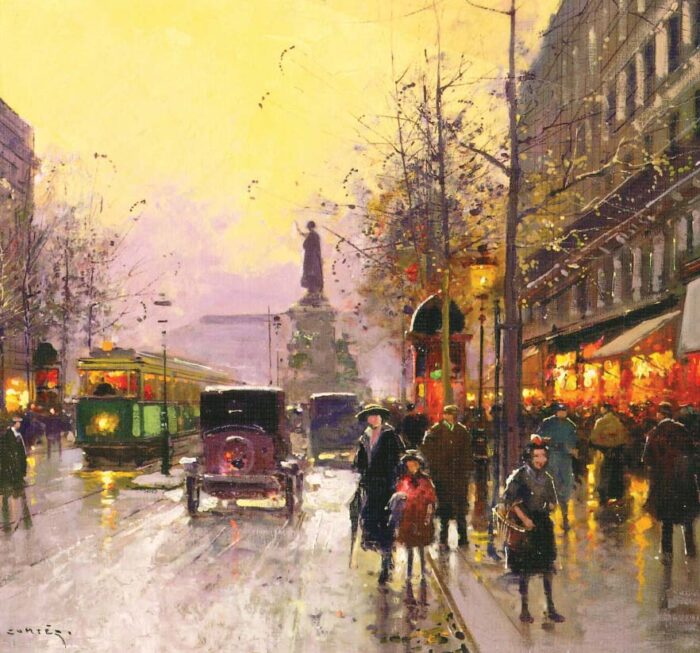
The accompanying scene is of Paris on Remembrance Day more than a hundred years ago. World War One had not long ended and its carnage and loss of millions was very poignant. On today, November 11 crowds gather in many lands, including Australia to mark Armistice Day and honour the supreme sacrifice of so many including more than sixty thousand of Australians “forever young”.
***
There have been numerous great accounts of the World Wars by distinguished writers. Top of the list in this country are the late Les Carlyon and prolific author Peter FitzSimons. Both wrote moving and factual books which became best sellers. FitzSimons wrote in one of his books about an incredible game of cricket as follows.
It was undoubtedly the most extraordinary game of cricket played. History records not a jot of who batted, bowled or fielded, nor even whether there was a result, but its extra-ordinariness relies on nothing as trivial as the score. It was where it was played that counts, and in what circumstances.
Gallipoli, December 1915. The battle had been lost, the struggle foregone. General Kitchener gave the orders to pull the Anzacs out and send them on to the Western Front in France. Under cover of darkness, the evacuation began on December 8. Over the next 11 nights, 35,445 men were safely evacuated on to the ships, suffering only one minor casualty in the process.
As the ranks begin to noticeably thin, it is decided that something should be done to alleviate whatever suspicions Johnny Turk might be harbouring about the decreased activity. The orders go out from First Division command that each battalion is to be as active as possible within sight of the Turks, primarily to create the impression that these visible men are the tip of the iceberg of the troops still in the trenches (many of whom have since departed).
Each battalion is to interpret these commands as it sees fit. Many choose to have men loitering about, gazing at the sky, just beyond the range of the enemy guns. Some men from New South Wales 4th Battalion have other ideas, though. Why not a cricket game? (Apart from mortar and rifle fire from the trenches above, that is.) The relationship between the Turks and the Anzacs have evolved by this time to the point where taking potshots at distant figures is not absolutely automatic but, on the other hand, the departing hospital ships are full of diggers who have trusted this line of reasoning too far.
It is a tentative group therefore who, on the afternoon of December 17, set foot onto the pockmarked patch of ground known as Shell Green (so named because it is under permanent Turkish artillery fire). The Turks in the trenches above must be wondering what on earth is going on as the game starts. Is this grenade-throwing practice? Or perhaps a method of whacking incoming grenades back to the trenches whence they came?
Who knows what they think, but for the first two hours of the game the Turks hold their fire and watch. But after two or three , hours the Turks have had enough of this strange spectacle, and start to send down some mortar fire to clear the Australians out. The Turks probably still didn’t know what was happening, but wanted whatever it was stopped. Did the mortar stop the cricket cold? Not bloody likely. According to the diary of one Granville Ryrie, quoted in Bill Gammage’s book The Broken Years, the game continued anyway, ‘just to let them see we were quite unconcerned … and when shells whistled by we pretended to field them. The men were wonderfully cheerful and seemed to take the whole thing as a huge joke.’
‘The shrapnel cut and hissed across the pitch and the outfield,’ the Australian War Memorial chronicles, ‘and there was as great a risk of lost life as a lost ball.’
When the Australians still didn’t retire, the Turks unleashed doubly heavy salvos of mortar fire and, to use Gammage’s phrase, ‘the Australians reluctantly called it a draw and retired to tea’.
Happily, there is no record of any player having to ‘retire hurt’, or worse, during the game.
Two days later, all players were safely evacuated to either be killed on the fields of France or to survive and make it homehome to Australia.
Shell Green now serves as a cemetery for fallen Anzacs.
VARIA

The opening Ashes Test begins at Perth Stadium on November 20. Sellout crowds are assumed at each of the five venues, especially on the first three days. The epic rivalry dating way back to 1877 has enthralled countless millions and inspired vast amounts of books – both prose and poetry. Pace bowlers are likely to dominate the series.

