Home Blog Page 857

Rob Mitchell: ‘community projects ignored’

MEMBER for McEwen Rob Mitchell has called out the Federal Government for ‘short-changing’ regional communities as it ignores calls for more funds for a grass roots grants program.

Mr Mitchell said he wrote to Prime Minister Scott Morrison urging funding the Stronger Communities Grants, SCG, program was doubled to meet communities’ needs. The program provides grants between $2500 and $20,000 to organisations and councils for small capital projects that provide social benefits for communities.

Under current guidelines each electorate can take applications for a maximum of 20 projects, valued in total at $150,000.

But in the latest round, Mr Mitchell received applications for more than 70 projects in the McEwen electorate, with a total value of $1 million.

Mr Mitchell said the locally-based consultative committee formed to review expressions of interest for round six of the program had their work cut out for them.

“We were genuinely overwhelmed with the unprecedented level of interest in the program this year,” he said.

“This huge uptake could be due to a range of factors including the lack of opportunities for groups to fundraise due to the pandemic, but also because the program has been a proven driver of enthusiasm and inspiration for our local groups and organisations to improve and expand facilities and services within their areas.”

Mr Mitchell said the government had not increased the total nationwide funding pool since the program’s inception in 2015 and now the inspiration and enthusiasm was being replaced by defeat and discouragement.

“These applications are almost all from local community volunteers and this program is now creating more losers than winners,” he said.

“While the requirement for matched funding was removed for this round, it didn’t go far enough to support the many community organisations who have struggled to continue throughout the COVID-19 pandemic.”

Mr Mitchell said the needs of growing electorate, with its mix of urban and semi-urban communities, smaller rural towns and villages and regional towns, were increasing enormously, while the level of funding had been stagnant.

“The SCP is now fast becoming a victim of its own success, with more applications having to be rejected due to massive oversubscription, and the losers are not just those hardworking volunteers putting in their time and effort on the application, but the communities they serve,” he said.

“The government needs to acknowledge that electorates like McEwen include many towns and villages needing improved facilities, unlike urban electorates which have their facilities and services concentrated in small area.

McEwen has more than a dozen towns, such as Kilmore, Lancefield, Riddells Creek and Gisborne that all need their own dedicated facilities, such as CFA stations, sporting facilities, community halls, etcetera.

“The PM should recognise the difficult circumstances we’ve found ourselves in during the pandemic and acknowledge the gaping need to support the many worthy groups that will unfortunately miss out.”

The Prime Minister’s office responded to Mr Mitchell by saying the government had committed more than $122 million over six rounds for more than 10,000 projects across Australia. It also said the government backed communities, including more than $550 million in measures to help regional areas.

Mr Mitchell described Mr Morrison’s response as ‘a word salad with no meaning’.

“Typically, the PM hasn’t said yes or no. For what it’s worth, he tells me he’s flick-passed it to the Deputy PM, with a cc to one of his Victorian Senators,” he said.

“It doesn’t sound like he cares too much about the many great proposals for our communities.”

Ryans Creek Reserve receives $1 million facelift

A $1-million transformation of Kilmore’s Ryans Creek Reserve was given the tick of approval by councillors, state politicians and, most importantly, children at an opening this month.

The reserve, in Kilmore’s booming west housing precinct, now features play equipment, a basketball half-court, picnic areas, a barbecue, connecting pathways and solar lighting.

The upgrades were funded through the State Government’s Growing Suburbs Fund in 2018-19, and Member for Northern Victoria Jaclyn Symes was on hand to celebrate the park’s official opening on March 12.

Ms Symes said the upgrades would provide a social meeting point for residents of western Kilmore.

“Ryans Creek Reserve is a large parcel of land that is right next to the fast-growing western part of Kilmore, so there is a lot of housing development and a lot of families,” she said.

“It was pretty much a paddock last year, so it was one of my personal priorities. Having a park that’s large and attractive – other than just Hudson Park – for a community like Kilmore was a good investment. Over the years it will become a really good place for the people in that area to come together.”

Mitchell Shire Mayor Rhonda Sanderson said she was proud council could provide access to quality parks for the area’s residents.

“It’s great for their physical and mental health and it helps bring people together and create a real sense of community,” she said.

“The Ryans Creek Reserve activation project will help improve the area as a community gathering space – a key site in Kilmore’s open space network.

“Longer term, the reserve will form part of a larger, connected network of parks for our growing residential areas in Kilmore’s west.”

Ms Symes said the park was sure to be popular with families.

“There are barbecue areas and shade facilities, so it’s a pretty cool little place for people to come together. My kids were certainly happy to entertain themselves there while we were there,” she said.

“Since I’ve been elected, $21 million of state money has gone to projects in the community between Broadford and Beveridge, and a lot of them are for projects focused on families – community centres and the like.

“It’s always great working with Mitchell Shire Council. We have similar priorities in terms of what we want to support.”
More information on the Growing Suburbs Fund is available at www.localgovernment.vic.gov.au/grants/growing-suburbs-fund.

New rose bushes for Kilmore Public Cemetery

THIRTEEN white rose bushes now adorn Kilmore Public Cemetery after cemetery trust members undertook beautification works at the site earlier this month.

Trust members spent several hours earlier this month planting the roses as part of the first stage of a memorial garden.

Kilmore Public Cemetery Trust president Madeleine Laming said it was important to continue to upgrade and preserve the site.

“It’s a very old cemetery. It was gazetted in 1850 and the first recorded burial was later that year,” she said.

“We’re working on beautifying the grounds and making it attractive to the public.

“The rose garden was planned about four years ago, but we had to finish the rotunda, get some money and get organised.”

Dr Laming said money for the work came mainly from government grants and donations to the cemetery trust.

“Cemeteries don’t have any income apart from the fees that they charge, and fees are capped for obvious reasons, so we mostly rely on government grants,” she said.

Trust members Graham Thompson, Bob Humm, Dean Saita, Eric Javor and John Schwartz were also involved in the beautification works.

“These roses are called memoire and they came from Silkies Rose Farm out at Clonbinane,” Dr Laming said.

“The headstones for the plaques have been made in Seymour. We’ve got a policy of supporting local businesses within Mitchell Shire.”

Mitchell Shire Council rejects Broadford subdivision

MITCHELL Shire councillors have rejected a proposed multi-lot subdivision at 540 Davidson Street, Broadford, dismissing it as ‘not good planning’.

The proposal involved the creation of five lots of between 591 and 682 square metres, with a common property access lane running parallel to Davidson Street.

The plan would also have entailed the removal of three native trees within the Davidson Street road reserve.

Although council officers deemed the permit application to be compliant with the Mitchell Planning Scheme and recommended it be granted subject to conditions, several councillors spoke against it.

Cr Fiona Stevens proposed an alternate motion to reject the permit outright, which was carried unanimously.

Cr Stevens said the permit application did not adequately factor in the long-term growth of Broadford, including the fact that Davidson Street was earmarked for a future connection with Rupert Street, linking the east and west parts of Broadford south of the train line.

“The [draft] Broadford Structure Plan is speaking to the future of this road being a connection across Sunday Creek to Rupert Street,” she said.

“The significance of this is high, in that that road is an alternate route. If the Hamilton Street bridge goes down, currently people would have to travel 12 kilometres [around to get into town].

“The report says the road won’t go through for 20 years, but I think the people of Broadford might have something to say about that. It’s quite a significant alternate connection … that currently is non-existent.”

Cr Stevens said she had other issues with the proposal.

“It’s got this internal road along the front of it, and yet it faces onto a road. It provides poor integration to the streetscape, as the internal road runs parallel to the existing road reserve – that’s just dumb planning,” she said.

“The internal road does not provide for the safe and efficient collection of waste and recycling. There’s talk in the report about the developer providing private waste collection – it’s not necessary.

“The small lot size does not respond to the existing subdivision pattern and character of the area. The blocks for the proposed subdivision are 591 to 682 square metres, yet the surrounding blocks are 1500 to 4200 square metres. How can we say this is compatible with the surrounding area? It’s not.”

Councillors agreed a link between Davidson Street and Rupert Street was vital for long-term future of Broadford and the planning application needed to factor it in.

“The most blindingly obvious problem associated [with the application] was that Davidson Street has been identified in the [draft] Broadford Structure Plan as going to be a connector road, and yet that point doesn’t seem to have been taken into account,” Cr Annie Goble said.

“There’s an access lane on the developer’s land that reduced the size of the blocks and then disallowed garbage collection.

“When Davidson Street is formalised and taken through … you would have a road running parallel to a service road within the boundary of a property. It seems to me very unusual planning.

“It makes far more sense to have these individual blocks fronting Davidson Street, rather than a service lane that disallows garbage collection.”

Cr Bill Chisholm said getting road connections right was ‘all-important’ for the future of the shire’s towns.

“Council cannot afford to do a lot of this roadwork themselves, so any time we can use a developer to fund some of this infrastructure, whether it’s drainage or streets, we’ve got to take advantage of that,” he said.

Cr Rob Eldridge was concerned the removal of the internal road would mean more native vegetation was lost but said the logistical benefits of the planned link between Davidson Street and Rupert Street were too great to compromise.

“I suspect we’re going to lose quite a few trees with this, however from a strategic point of view the link through to the other side of the creek really does outweigh it,” he said.

Kilmore Fire Brigade call for Good Friday volunteers

KILMORE Fire Brigade Lieutenant Dionne Quinn hopes to rally some more volunteers for the 2021 Good Friday Appeal to raise much needed money for the Royal Children’s Hospital.

Lt Quinn said the importance of the appeal to the community was immeasurable, and after a difficult year of fundraising in 2020, she hoped 2021 efforts would gain traction.

“You never know if and when your family, friends or neighbours may need the Royal Children’s Hospital,” she said.

“We are so excited to be back door-knocking this year. It may also help the community feel like normality is coming back in.

“After the horrible year everyone had last year, it’s going to feel so good being back out there.

“People can either donate with the door knockers, drop off at the Kilmore Fire Station in Conway Street on Good Friday from 9am, or via the virtual tin shake on the brigade Facebook page.

“[We are] looking for volunteers to help out with door-knocking. Either send a message through the Brigade Facebook page or email admin@kilmorefirebrigade.org.au.”

For more information, visit Kilmore Fire Brigade’s Facebook page.

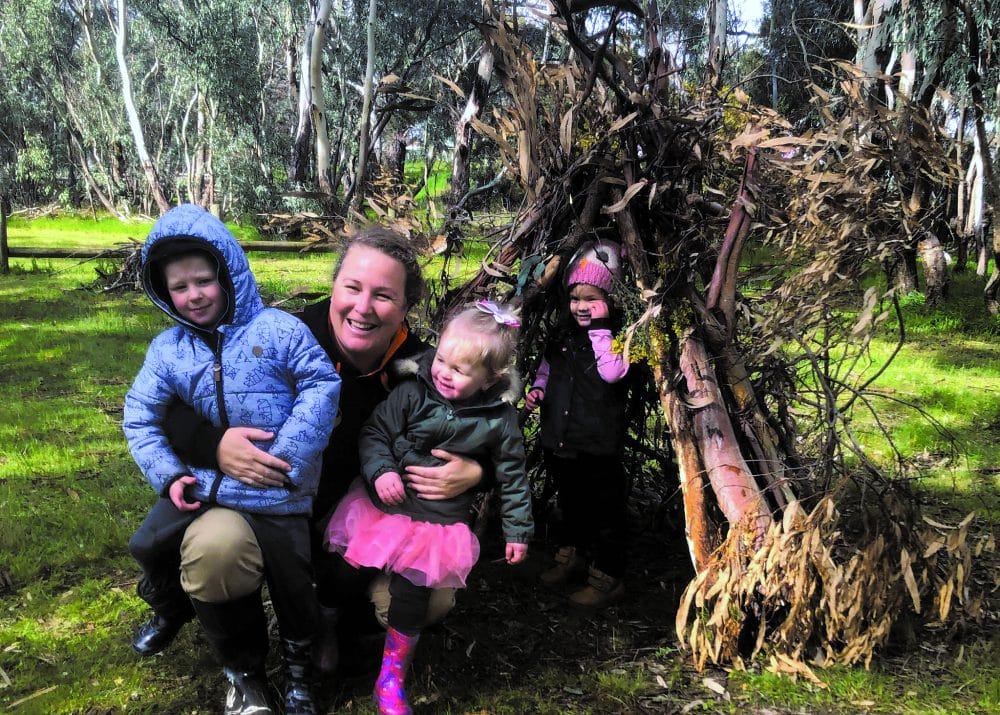
Mitchell Shire nature-play program to expand

By Steph McNicol

MITCHELL Shire-based nature-play program The Bush Bus has triumphed and is now expanding interstate.

The program, created by Georgina Dymock, founder of Kidding Around Australia, aims to engage children by allowing them to enjoy sensory imaginative play.

Activities include nature-inspired arts and crafts; water, mud and puddle play; and educational nature walks and talks to uncover Indigenous flora and fauna of their local area.

The Bush Bus, initially funded through the State Government’s Pick My Project initiative in 2019, has overcome hurdles along the way, incluing the COVID-19 pandemic and funding challenges.

DSC 4225
The Bush Bus founder Georgina Dymock and participant Violet Collier.

The program originally started with a small group of children at locations throughout Mitchell Shire each week, but has now expanded to several school visits, and travels to Moama, New South Wales.

Ms Dymock said while COVID-19 impacted what the group was intended for, it was able to overcome the challenges and secure further funding.

“The COVID-19 restrictions impacted our program immensely as we were unable to run in-person sessions. In order to keep our little Bush Bus Buddies connected we ran Bush Bus Online sessions throughout 2020,” she said.

“In 2019, we welcomed over 6000 participants in Mitchell Shire. In 2020 and 2021 we obtained sponsorship from Frasers Property, which allowed us to expand to The Grove in Wyndham Shire and Life, Point Cook in Hobsons Bay Council as well as maintaining two days per week in Wallara Waters and the Broadford Common in Mitchell Shire Council.

“We were also successful in obtaining funding from the NSW government’s Stronger Country Communities Fund, round three, to run The Bush Bus in Murray River Council, and Mitchell Shire Council to run eight sessions at Tooborac Primary School in term two and term four, 2021.

“We will be in Moama two days per week on Tuesdays and Fridays and will be running two regional tours throughout Murray River Council twice per year.”

DSC 3500 1 1 rotated e1616461065610
Violet Collier, three, enjoyed playing with paint as part of the nature-based creative play.

Ms Dymock said she was grateful for the funding support by the community.

“Our weekly Victorian sessions are supported until the end of May by businesses such as Frasers Property Australia, Quantam Comms, Wellington Square Shopping Centre, Kilmore and Seymour Toyota,” she said.

“We are so grateful for the support we have received and look forward to securing funding for spring and summer 2021 and for 2022 in the coming months.”

The Bush Bus will host special pop-up Easter session at Wallara Waters, Wallan from 10am to 12pm on March 27; and at Point Cook on March 28. It also visits Tooborac Primary School.

.

Broadford Secondary College launches Fathering Project

BROADFORD Secondary College will implement an initiative for the first time, a project aiming to bring together fathers of the community to create a support network for parents and guardians.

The initiative, The Fathering Project, will begin early next month after an information night inviting fathers and father figures to attend. Father figures can include uncles, grandfathers or other guardians.

The Fathering Project is a nationwide program aimed at providing support and resources to fathers so they can have a meaningful connection with and impact on their children.

Organisers of the project, Broadford Secondary College’s student wellbeing coordinator Jason Gatt and wellbeing team member James Pateras, said their aim was to build a community of fathers to support each other.

“The Fathering Project aims to improve child development outcomes by inspiring and equipping fathers and father figures to effectively engage with their kids,” Mr Gatt said.

“It’s a school-based dads’ group that involves programs and events specific to the engagement style and needs of dads and father figures.

“Fathers and father figures can be involved for whatever period they choose to be part of the project.”

Mr Gatt said the project would aim to be inclusive.

“At Broadford Secondary College, we strive to be as inclusive of family as possible, valuing family engagement as a powerful contributor to best outcomes for our young people,” he said.

“[The program will aim] to support fathers and father figures to better understand their child and connect better with them, to provide men with the opportunity for mutual support – building a community of fathers/father figures where men feel cared for, and to support men in feeling connected … men can sometimes otherwise feel isolated, detached or disconnected.”

The wellbeing team said fathers had a significant impact on the academic, social and emotional wellbeing of children, which in turn meant they had a long-term effect on their adult life.

“An effective and engaged father or father figure helps to reduce alcohol, tobacco and drug use, reduce suicide and self-harm, increase health outcomes, increase self-esteem and resilience, and reduce bullying behaviours,” Mr Gatt said.

“Effective and engaged fathering also helps to increase social responsibility and social maturity, reduce engagement in unhealthy and risky behaviours, increase physical activity, and increase student connectedness with school and better academic outcomes.”

The organisers said fathers were invited to a launch event next week that would provide information about how they could get involved in the program.

“The one challenge we may encounter is how we go about creating enough safety and comfort for the fathers and father figures to attend the group,” Mr Gatt said.

“We are aware that some men may feel a lack of confidence in coming along – all we can say is, please give yourself and us an opportunity to help you feel included and welcomed.

“[We want to provide] enthusiastic and engaging opportunities for fathers and father figures and children to connect … and to be part of a welcoming and supportive group.

“A highlight for the school would most definitely be seeing connections between fathers and father figures and their kids.”
People interested in participating and getting involved are encouraged to attend a launch event at 6.30pm on Wednesday, March 31 at the college’s main courtyard.

For more information or to RSVP, contact the college on 5784 1200, or email James Pateras on james.pateras@education.vic.gov.au.

Kilmore’s Tamara Ruffin a finalist in national award

By Aleksandra Bliszczyk

KILMORE early childhood educator Tamara Ruffin has been honoured at the 2020 national Excellence in Family Daycare Awards.

Family daycare is a form of childcare that focuses on each child’s individual development from the educator’s home.

Ms Ruffin has operated her own family daycare for nearly five years, working with children aged two to 11.

Ms Ruffin was one of four national finalists for the Family Daycare Educator of the Year Award, representing Victoria and Tasmania.

A total of 5660 family daycare educators were nominated, before 75 regional winners were chosen.

Ms Ruffin was named the winner for the Goulburn Valley region late last year, and was informed she was top four in the country last month.

“I didn’t manage to win the educator of the year but I’m quite happy with national finalist,” she said.

Ms Ruffin was nominated by the families of children in her care after she donated almost 700 bat wraps and joey pouches to bushfire-affected animals in early 2020.

The wraps act as swaddles for injured or orphaned baby bats and flying foxes as a substitute for their mothers’ wings.

Wildlife carers across Australia were in dire need of these wraps last summer as bats were acutely affected by the country’s megabushfires.

About one third of Australia’s native flying fox population perished, while dehydrated pups were seen dropping from trees in Victoria and South Australia.

“We had a lot of people donating whether it was blankets or sewing goods as well as even just beds and pillows,” she said.

Ms Ruffin taught the children in her daycare and their families to both hand-stitch and sew using machines, before Federal Member for McEwen Rob Mitchell collected the finished products and funded their distribution to animal shelters in bushfire-affected areas.

“It all came through really to help children understand,” she said.

“Victoria had big bushfires but also you could smell it in the air … it was a way to stay connected and help [children] understand why our environment was changing, why everybody was panicking. Everybody was being affected in some way.”

Since the pandemic hit, she said the needs of her children and families had dramatically changed.

“Coming off a year where you were able to do big projects and people were very willing to be involved to a year of COVID, and the uncertainty of whether it’s going to be the right time to … extend the children’s learning,” Ms Ruffin said.

“The biggest focus for me right now is actually staying still and processing and understanding what my children and my families need, and at the moment they need a safe secure environment.

“We’ve got a new group of children so we’re all just starting to get to know each other, really taking it slow this year.”

Kilmore and District U3A elects new committee

Securing a new home for Kilmore and District U3A will be forefront for the new committee elected at its annual general meeting last week.

The group elected new president Mavis Wilcox, who will take over from the retiring Rupert Hussey.

Ms Wilcox, a long-time member of U3A, said she appreciated the ethos the community group espoused.

She also has experience in dealing with council on behalf of community groups – an attribute that will be needed as U3A negotiate with Mitchell Shire Council to find a new home.

Mr Hussey reported at the meeting the group was still waiting to hear from council about an eviction date from Kilmore Family Centre in Skehan Place.

The centre is set to undergo reconstruction.

Mr Hussey said the ongoing discussions with council staff were encouraging and they had advised they were doing everything possible to find the U3A group a new home.

He also told the meeting, at Kilmore library, he was pleased the club membership was stronger than ever.
Current membershp is at 187, and growing.

Committee member Dawn Barr said Mr Hussey was to be congratulated on keeping the group functioning through a difficult 2020.

“He was always conscious this was a difficult year for some members, especially those living alone. U3A is often their social outlet,” she said.

“Although a bumpy start to 2021 due to COVID restrictions, the group cautiously continues to move forward and it is pleasing to see a multiple course timetable with 23 courses offered.”

The new committee is: vice-president Norma Newman, secretary Mark Perrott, treasurer Glenda Curr, committee members Cheryl Spencer, Dawn Barr, Elaine De Gabrielle, Catherine Smith, Lorraine Shaw, and Wendy Brancasitano.