




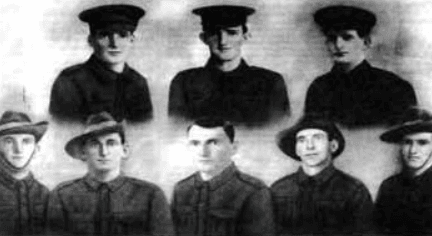
THE SPIRIT OF ANZAC
Along with countless others from all areas of life, many footballers and cricketers paid the supreme sacrifice in the two great wars.
Among remarkable stories that have survived down the years is the true one of the Aussie cricketer, a brilliant outfielder, who in the conflict of 1914-18, spent hours on end catching enemy grenades and hurling them back to explode whence they had come from.
As Anzac Day approaches, this column quotes from a celebrated speech given at a dawn service at the Shrine of Melbourne.
The speaker was Neville Clark (AM) a former hugely admired headmaster of Mentone Grammar. Neville, winner of the Military Medal in Vietnam, was a great host to ACK students whenever they visited Mentone for summer and winter sports.
***
The countryside is bouncing back thanks to autumn rains breaking the long “dry.” A tough breed the men and women across our vast land who battle the elements and government bureaucracy, to ensure there is food for the population. Sadly, many farmers male and female have taken their lives in the past year due to crippling circumstances.
***
Lest We Forget
“We come to this sacred place, not to glorify; certainly not to celebrate (the modern cult of celebrity would have been unrecognisable at Anzac: as CJ Dennis’s Ginger Mick knew, “it’s crook to tell, a tale that marks for praise a single one”). If we are true to the purpose for which the shrine was built, however, we come to commemorate. The Australian and New Zealand Army Corps gave to two new nations a new spirit which neither of them could have imagined before.
“Australians and New Zealanders knew they had to fight in 1914 because they knew the cost to themselves if the British Empire should go down, they’d go down with it. Australians and New Zealanders have not fought in wars to gain anything; Australians and New Zealanders have fought in wars not to lose something – freedom. To protect their new nationhood – and their freedom – the Anzacs went to war with a spirit of determination, which has marked their successors ever since.
“The determination, for instance, of the tragic, successive waves of the Light Horse in the charge at the Nek in order to give the equally heroic New Zealanders the best chance of seizing Chunuk Bair, tactical key to the Gallipoli Peninsula.
“The determination shown at Passchendaele by the machine gun section commander who wrote down his orders for his section, all of whom had – like him – volunteered to man a potentially fatal outpost. His orders?
1. This position will be held and the section remain here until relieved.
2. The enemy must not be allowed to interfere with this programme.
3. If the section cannot remain here alive, it will remain here dead, but in any case, it will remain here.
4. Should all the guns be blown out, the section will use Mills grenades and other novelties.
5. Finally, the position, as stated, will be held.
“The section did indeed remain until relieved, fully 18 days later, and these orders became so famous along the Western Front that for many years they were promulgated in British Army orders and, in 1940 at Dunkirk, were hailed in the press ‘as the spirit that won the last war.’ And the author, and section commander? A Tasmanian clergyman.
“The determination for the bomber command aircrews to fly straight and level through the death zone to give themselves the best chance of hitting their targets in the Ruhr Valley.
“The determination of the captain and crew of the HMAS Yarra to protect a three-ship convoy by steering, their own diminutive craft directly into the path of the Japanese heavy cruiser squadron.
“The determination of the walking wounded from Kokoda not to clog up the ‘fuzzy-wuzzy’ stretcher line but to keep moving themselves, if necessary, by crawling on their knees.
“The determination of the POWs that no Australian should die alone on the Railway of Death.
“The determination of the nursing sisters to maintain their honour and show no fear to their captors after the Bangka Island massacre.
“The determination of the exhausted division in the pivotal coastal sector at Alamein to bring upon themselves, if necessary, the whole weight of the Afrika Korps counter attack to enable a break out further inland.
“The determination to mount the slopes of Maryang-San, to advance through the rubber trees of Long Tan, or to search through the green valleys and up the desert crags of Afghanistan.
“The determination to keep the home fires burning until the boys came home.
“This spirit of determination has led inevitably to sacrifice, not just the fact of sacrifice which, between 1914-1918 for instance, resulted in irreparable loss for two young nations, but also a spirit of sacrifice, a team spirit if you will, through which many lives were saved by selfless acts of courage, for the sake of comrades in arms, and ultimately for freedom.
“Greater love hath no man than this, that a man lay down his life for his friends.”

