

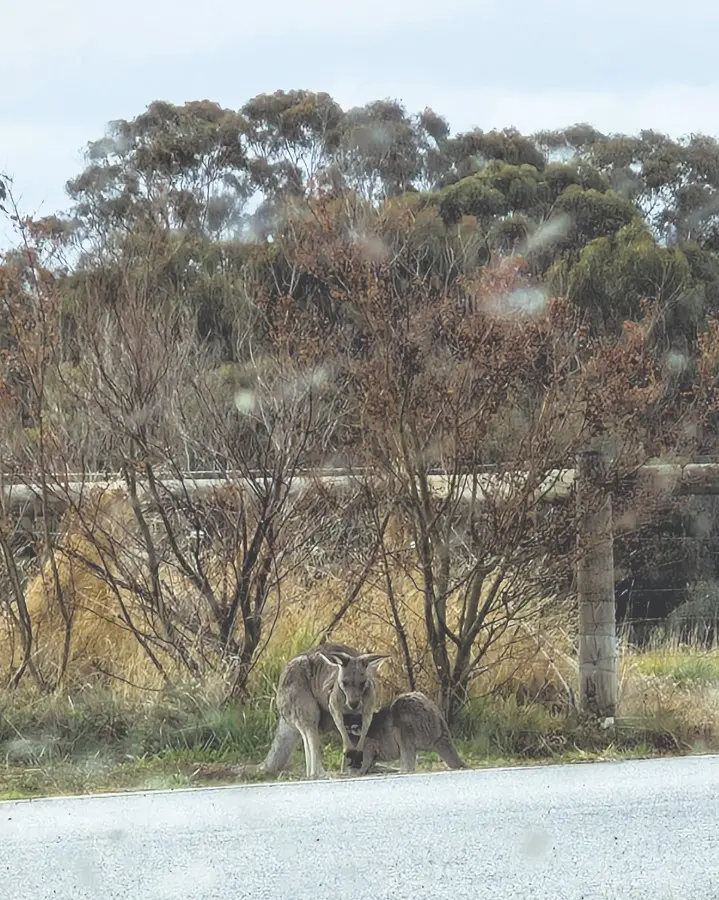


ALARM bells are ringing across the Mitchell Shire as kangaroos are impacted by development of the Northern Urban Growth corridor as its road networks, infrastructure and housing developments are changing the landscape.
The risk of the Phalaris Staggers, a condition coined in agricultural circles that came about because animal consumption of the grass causes behaviours similar to drug and alcohol intoxication, could be the number one reason that seriously maimed or dead kangaroos are seen more often on suburban and rural roadsides.
Robyn Coy is in her 70s and is an authorised wildlife rehabilitator residing in Euroa.
With a Ph.D in Ecology and Evolutionary Biology and honours in animal physiology, Dr Coy said Phalaris grass has been introduced by Europeans and is out of control.
“Phalaris staggers affects the brain,” she said.
“It’s a toxin running around in the brain that creates havoc and eventually kills the brain cells.
“Livestock including horses, sheep and cattle are also affected, but it’s hard to get the interest because kangaroos are not a commercial species.”
Member for Euroa Annabelle Cleeland raised concerns at a June Parliament sitting calling for urgent action on escalating kangaroo numbers from a residents’ point of view.
“People driving on rural roads are genuinely frightened,”Ms Cleeland shared with the Review.
“In the early morning or around dusk, it feels like a kangaroo could jump in front of you at any moment.”
Animal Justice Party MP Georgie Purcell responded on social media to Ms Cleeland claims that kangaroo populations are exploding.
“The misinformation being spread about kangaroo populations is deeply frustrating, especially when it’s picked up and repeated by people in positions of influence,” she said.
While a farmer can remove their livestock from an effected pasture and even treat them with an agricultural agent, cobalt, this does not change the outcome for kangaroos and more importantly it does not address the grass growing on unkempt roadsides or paddocks that are ungrazed.
Dr Coy also said it’s not an issue with populations.
“I’ve yet to see a starving Kangaroo that hasn’t got a secondary problem such as worn teeth,” she said.
“We don’t have a plague.
“We have the same number of kangaroos who are now being forced into areas where they are move visible and they are not prolific breeders.
“A doe is age three before she can produce a joey. She has one per year and her two-year-old joey (if it survives) will still be with her as an ‘at heel’ joey for two years.
“Kangaroos only take the top of the grass, so they are not competing with livestock.
“While they do have an impact, they are also an integral part of our environment.
“They are soft footed…and their toe nails aerate the soil. This soil disruption is a gentle form of ploughing and irrigation.
“Mineral traces near their sleeping hollows are higher than anywhere nearby.”
Fellow wildlife rehabilitator, Narelle Smith said the impact of Phalaris Staggers around Wandong is horrible and there is a lot, even for wildlife rescuers to learn.
“It’s not necessary a quick death,” she said.
“It’s a traumatic experience for everyone involved, and it’s cruel to prolong the death of an animal. Every few years it’s having a massive impact [on kangaroo populations].
“Only a Creatine Kinase (CK) ratio blood test can exclude the condition which is renal failure and stress myopathy.
“Not all of the herd is affected, its random…they do tend to be on their own, whether this is due to disorientation or to protect their herd.
“I’ve never seen a wallaby with it, but whose to know.”
The development of the Northern Urban Growth Corridor sees wildlife rehabilitators turning to their social media followers to help fund their rescue efforts as their operational costs include running and maintaining their vehicles, their household utilities, animal feed, shelter, fencing, and veterinary expenses.
“There’s unrealistic expectations on us,” Ms Smith said.
“Some of us get reimbursed by Wildlife Victoria with petrol vouchers and there’s grants to apply for…but this is not a desk job. We are on call 24/7.
“Twenty years ago, we pushed for better management with Council and developers…I don’t know where we could put them now.
“All they have done is create a land lock and its negligent that they are allowed to get away with it. Signs should go up to let people know that there are displaced animals in the area [due to development] but that would make them accountable.
“The developers make millions, but it’s up to me (and others) to clean up the mess, out of my own pocket and in my own time.”
The grass is demonised for another reason as the temperature rises outbreaks of Phalaris crops present another threat to wildlife, livestock and properties.
“The Phalaris Aquatica species should be removed from sale,” Dr Coy said.
“It’s outcompeting native grasses and it’s certainly becomes a fire hazard. It’s a sway of dry, dead grass and it grows up to five feet high.”
The Review’s sister newspaper, the Alexandra, Eildon and Marysville Standard contacted Murrindindi Wildlife Rescuer Kate Turner on the species, and she suggested “Cocksfoot.”
“It’s a great grass,” she said.
“It’s another introduced one, but it has zero negative impact on native wildlife.”
Sightings of wildlife with signs of Phalaris toxicity poisoning should be reported to a local vet, wildlife welfare organisation or the Department of Energy, Environment and Climate Action Customer Contact Centre on 136 186.


