

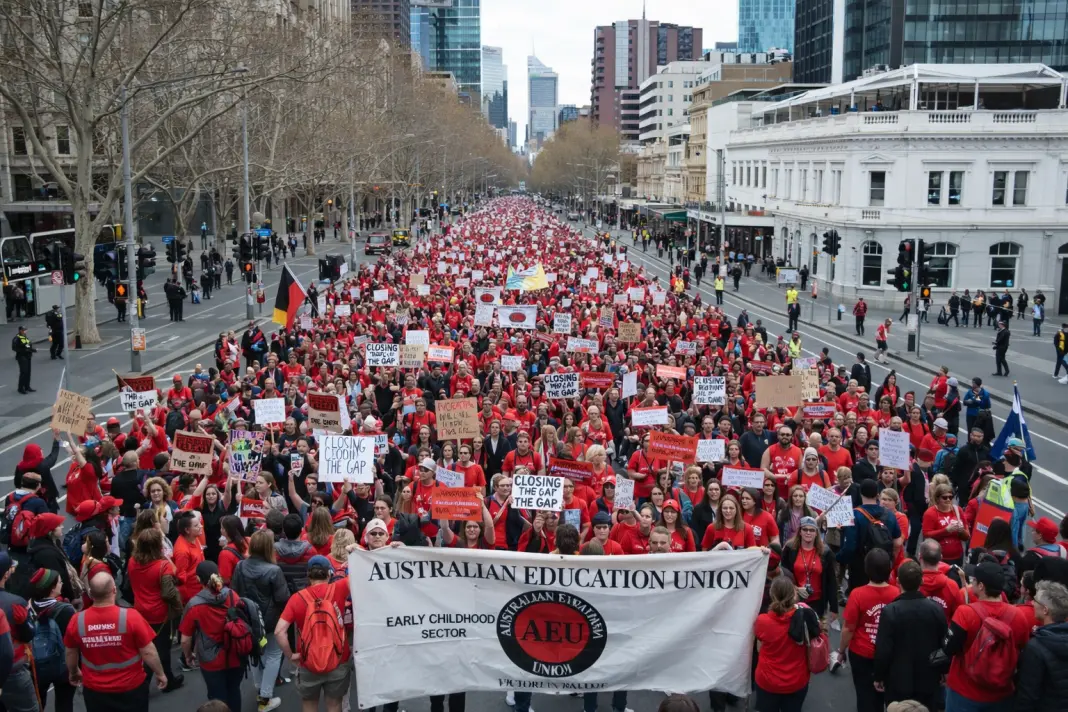



VICTORIA’S claim to be the “Education State” has been thrown into sharp doubt, with tens of thousands of teachers walking off the job last week in the largest education strike in more than a decade.
Classrooms across the district were disrupted as local educators joined industrial action led by the Australian Education Union. Schools in Kilmore, Broadford, Wallan, Wandong, Seymour, Willowmavin and Whittlesea were all impacted, forcing families to scramble for alternative arrangements.
For the State Government, the strike marked a significant escalation in a dispute that shows no sign of easing.
At the heart of the standoff is a widening gulf between what teachers say they need and what the government is prepared to offer. The union is pushing for a 35 per cent pay increase over four years, arguing Victorian teachers have fallen behind interstate counterparts and are now among the lowest paid in the country. The government has countered with an offer of roughly 18 per cent, maintaining it is both fair and fiscally responsible.
But for many teachers, the dispute goes far beyond wages.
One Kilmore-based teacher, who asked not to be named, said the pressures inside classrooms are reaching breaking point.
“If Victoria is serious about its ‘Education State’ branding, it must confront the reality inside its classrooms, where teacher shortages, burnout and declining morale are becoming entrenched. Our schools here are feeling the strain, often struggling the most to attract and retain staff,” The teacher said.
What has become increasingly clear, however, is that teachers are not standing alone.
Across the region, parents and community members have rallied behind educators, voicing strong support for their demands and recognising the pressures facing schools. Many families, despite the inconvenience of disrupted learning, say the strike has highlighted deeper systemic issues that cannot be ignored.
Wendy (not her real name), is a parent of two children at Wallan Secondary College, said she supports the action despite the challenges it created for her family.
“It wasn’t easy organising care at short notice, but I completely understand why teachers are doing this. They’re stretched too thin, and that affects our kids. If we want quality education, we need to support the people delivering it,” she said.
This growing community backing is shifting the tone of the dispute. What might once have been seen as a pay fight is now being viewed more broadly as a stand for the future of public education, particularly in regional and outer suburban areas where staffing shortages are often most acute.
The strike has also intensified public scrutiny of the government’s long-standing “Education State” slogan. Critics argue that branding alone cannot mask the challenges facing schools on the ground.
One thing is clear, another parent told the Review, is that this dispute is no longer confined to negotiations behind closed doors. And until it is resolved, the title of “Education State” will continue to ring increasingly hollow.


