

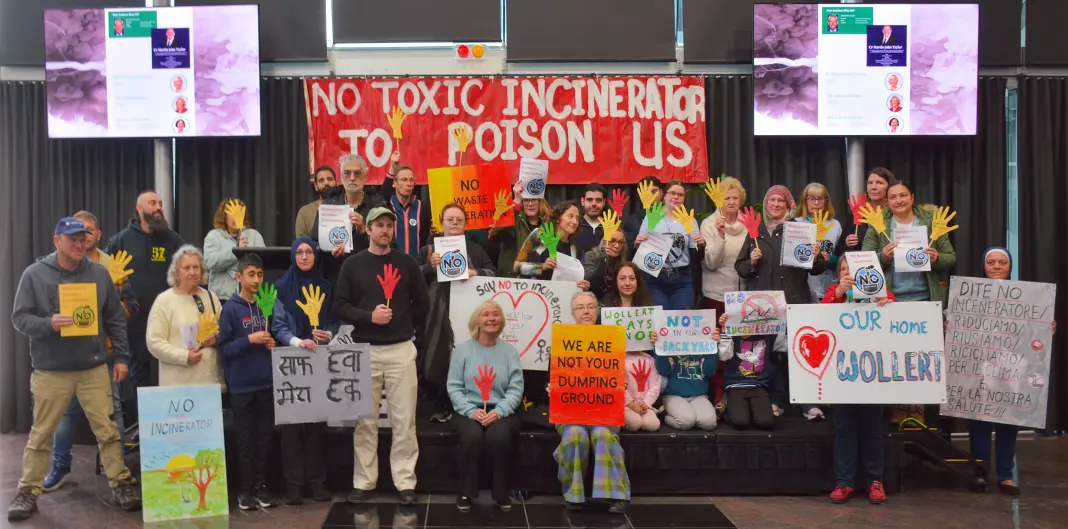




WOLLERT’S planned Melbourne Energy and Resource Centre (MERC) is still a talking point across the community, with continued opposition from a group against the proposal making their feelings heard as Cleanaway held its Annual General Meeting.
An online information session was held last month to discuss MERC, with presentations from Cleanaway Executive General Manager for Energy from Waste Preet Brar, Head of Energy from Waste Michael Hartley and Tract Senior Principal Town Planner Katie Murphy, while the third and final in-person community information session was held on Saturday.
Ms Brar said in the online presentation last month that MERC would process enough unrecyclable waste to power thousands of homes.
“Through processing this waste at MERC, we will generate enough electricity to power 120,000 homes,” she said.
“In the process, it will also recover 200,000 tons of ash and metal for reuse, and we’ll safely dispose of 30,000 tons of air pollution control residues to prescribed landfills.
“This technology, it’s important to note, is not experimental. It’s proven European technology, with more than 500 plants safely operating across Europe.”
Through the process, the incinerator must also meet EPA Victoria’s air quality rules, while independent experts will assess the air quality and health risks.
Ms Brar also said throughout the presentation that Victoria was forecast to send an estimated 8.9 million tonnes of waste to landfill each year, the equivalent of almost 5000 swimming pools, or 9.5 MCGs.
Mr Hartley addressed community concerns in the webinar.
“Cleanaway will need to address a number of concerns that have been raised throughout our engagement sessions. With truck movements, we must manage vehicle access and routing to minimise congestion and impacts on local roads,” he said.
“Importantly, we can do this without havoc in any trucks’ roads through residential areas, but we’ll also need to implement dust suppression, low-emission vehicles where possible, and timing strategies to reduce any peak traffic disruption.
“The facility must use enclosed handling systems, silencers and odour control technologies to protect any nearby residents. In addition, the facility will need to maintain regular monitoring and compliance programs to ensure consistent performance and minimal nuisance.
“The MERC will need a robust safety and contingency system to prevent accidental release equipment failures, or bypass events. Emergency response plans and real-time monitoring will minimise risks if these events occur. And that’s been a regular discussion point for a number of our meetings.”
However, No Northern Incinerator Wollert group spokesperson Catherine Rouse said in a recent press release that, despite all these measures designed to protect the community, it still isn’t enough to appease their concerns.
“We want Cleanaway’s shareholders, board and executive to know that there is strong community opposition to these risky proposals, and we will be relentless in objecting to them. Those within the Cleanaway circles will have only seen the green and pink washing – and won’t know about the support that the local communities have in their objection to these toxic plans,” she said.
“Will Cleanaway pull the pin on incineration – or wait for the regulatory processes to stop them?”
The group is hoping to follow in the footsteps of events in New South Wales, where an incinerator proposed by Cleanaway was rejected in Western Sydney, while similar designs are now not permitted across Sydney.
The press release also made mention of how incinerators have been withdrawn from renewable energy credits.
“The regulatory environment for waste to energy incineration is moving to prioritise health and climate over quick fix waste disposal,” it read.
“With increasing knowledge on the impacts of pollutants, the Federal Government has withdrawn these incinerators from renewable energy credits, and does not include incineration in the Circular Economy Framework.
“Both NSW and Victoria currently have in-process upper house enquiries into this industry.”
The No Northern Incinerator Wollert group claims that this incinerator, as well as another being proposed for Queensland’s Scenic Rim, burns 1.5 million tonnes of rubbish together every year, with plans to operate for at least 25 years, while claiming that toxic ash would become part of the smoke plume.