

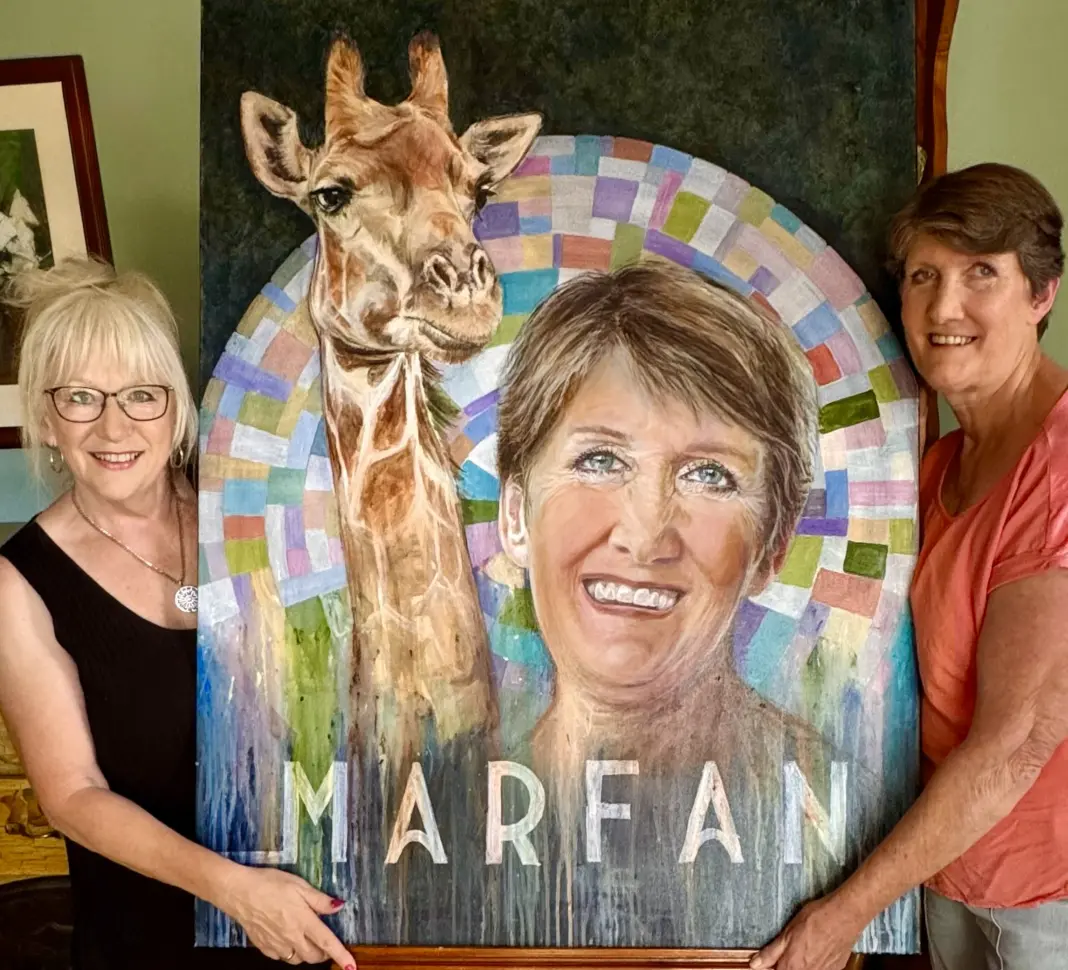


FEBRUARY marks Marfan month, with two locals in the Kilmore area bringing a light onto Marfan Syndrome, its effects and a special portrait to Broadford.
Local Sally Ferguson has had a portrait painted of her by close friend Louise Barnes to help bring Marfan Syndrome to the public domain, with Ms Barnes submitting the portrait to the 2025 Archibald Prize.
Sally has been able to navigate her journey with Marfan Syndrome since the 1960s.
It is a genetic disorder which affects the body’s connective tissue, which affects skeletal changes, particularly through limbs and joints.
Other conditions include vision impairment, which Sally credits with helping doctors understand what she was living with, and people with Marfan are often tall and thin.
A lifetime of living with Marfan, including marrying into a family which also came to understood Marfan entirely by chance, has allowed Sally to educate the wider community about the disorder.
“I had set up the Marfan Association of Victoria in 1997 and it ran until 2021. I was president for 13 years, and it went for a couple of years after I left, but it unfortunately folded,” she said.
“Everything is now online, which means it’s easier for people to access information.
“It’s important to me. I used to do a lot of public speaking and support for people who had Marfan. It’s my life, I live with it, and I wanted to give to others. It was rewarding and the best thing I could have done.”
Sally and Louise’s love of art helped bring the duo closer together, and it was Louise’s experiences of seeing Sally go through open-heart surgery which inspired her to create a piece to raise awareness.
“She wanted to do it because of my involvement with Marfan over the years. I questioned her choice, but she wanted to do it, and also to promote Marfan awareness at the same time,” Ms Ferguson said.
“She’s an amazing artist, and what she did for us putting Marfan on it, she put it into the packing room when you take the paintings in, and the first thing one of the packing girls said was ‘what’s Marfan’, so we got excited. It was what we wanted, it hit people instantly asking what it was and opening the conversation.”
Sally has not allowed Marfan Syndrome to get the best out of her passion for art.
“With Marfan, I have vision impairment. I tried to get into a fine arts ceramics course, and I did the year and I always failed at the end of the year. It was purely discriminatory. At the end of it, I requested reasons why I failed, as I passed all the written work. It comes down to the creative stuff,” she said.
“I set up a studio in Broadford. Both Louise and I have a huge love of art, which is a good connection for the two of us. It’s a special connection.
“I think she wanted to do the painting to coincide with my open-heart surgery. She had a connection there she wanted to put together which meant a lot to her and to me.”
A poster of the artwork is located in the Kilmore-Broadford bakery on High Street, Broadford, bringing awareness to locals about Marfan.
“When we were putting it up, everyone was looking at the window to see what it was. They were reading it, going up and looking at it,” Sally said.
“The giraffe has been a symbol for many of the Marfan groups, which is a great mascot.”
Unfortunately, Sally has also had some tough times watching those close to her live with Marfan Syndrome.
In 2024, Sally’s great-nephew Baylyn passed away at the age of six after he was diagnosed with severe early-onset Marfan Syndrome.
Sally reflected fondly on how her extended family has handled Marfan Syndrome.
“In the early 80s when little was known about Marfan, my sister-in-law kept going back to the Children’s Hospital with her son as she felt things weren’t right, and paediatricians didn’t pick it up, which is what the Connective Tissue Disorder Network of Australia (CTDNA) are wanting to do now, trying to ensure timely and accurate diagnosis,” she said.
“She went back to them and said his eyes are wobbling like my sister-in-law’s and she has Marfan syndrome. They then did an echocardiogram and eye test and they found it was a classic case.”
“For them to miss it in a child that was one year old… he was very tall for his age.
Baylyn’s case was picked up straight away since his dad had his diagnosis of classic Marfan but Baylyn was born with a severe form of Early Onset Marfan He filled the length of a cot at the Children’s Hospital. They went in to do the first open heart surgery, but they couldn’t go ahead with it as the heart was that enlarged, they couldn’t do the surgery required.
“His six years of life was filled with some horrendous things, but he was such a happy little fellow. Nothing worried him, he put up with anything he had, and it was what he knew, it was his life.”
Sally says the CTDNA’s work has been justified by having some of Australia’s most important monuments shining a light on Marfan Syndrome throughout February.
“It gets everyone talking. AAMI Park was lighting up on the day before Baylyn’s birthday,” she said.
“The Treasury Building was lit up on February 1, so that looked amazing.
“They have done Marfan month in America for quite a while, so it’s great to see it coming through and getting attention in Australia.
“When we started out years ago, the figures were one in 10,000, then it was one in 5000, but I read in the UK recently where it’s one in 3000.
“I’m amazed at how many Marfan-affected people there are in the township close by. I’ve worked with plenty of them around here.”

